Summary
Off-grid solar batteries should be compared on capacity, compatibility, longevity, budget and how well the battery bank matches the solar array and inverter to meet household demand through winter. 100UP uses a sizing method based on daily energy allowance per occupant plus about two days of autonomy, then adjusts for conversion losses and available solar recharge. Brands like Pylontech, Deye and Sigenergy differ in installation format, battery management systems and expansion limits, so warranty terms and inverter pairing need checking against the property's actual requirements.
Solar batteries store energy from solar panels for use when solar production is low or unavailable. When selecting a solar battery, capacity, compatibility, longevity and budget all play a role.
For off-grid systems, the battery bank needs to work with the solar array and inverter to meet household demand through winter and periods of low solar production.
Choosing and Sizing Solar Battery
Battery capacity is one consideration. Compatibility with the inverter, usable storage, charge and discharge rates, operating temperatures and expansion options also matter.
How 100UP Sizes a Battery Bank
We start with 5kWh per day for the house, plus 5kWh per person, allowing for realistic future occupancy. We then use approximately two days of battery autonomy as a starting point for getting through consecutive low-solar days in a Ballarat July.
How much power do you use a day?
1 person ≈ 10 · 4 people ≈ 25 · farm or workshop 35+
A starting point for getting through consecutive low-solar days in a Ballarat July. Your final battery size is confirmed against your site and how you use power.
For example, a home designed for four occupants:
- House allowance: 5kWh per day
- Four occupants: 4 × 5kWh = 20kWh per day
- Total daily demand: 25kWh
- Two days of autonomy: 25kWh × 2 = 50kWh of usable storage
This is an initial energy allowance, not the final battery specification. We then account for conversion losses, operating reserves, major loads and the solar available to recharge the bank. The solar array, batteries and inverter are designed together.
Read more about 100UP’s off-grid system design method.
Capacity and Usable Storage
Nominal capacity is the total rated energy storage. Usable capacity is the amount available within the battery’s operating limits.
Compare usable capacity alongside household energy consumption and the amount of solar available to recharge the battery.
Charge and Discharge Rates
A battery needs enough storage to cover the required period and enough power output to run the intended loads.
Continuous output and short-duration peak output are different specifications. Both need to suit the inverter and the appliances the system will supply.
Compatibility and Expansion
Some batteries require communication with a compatible inverter. Others use a self-managed battery management system.
Modular batteries allow storage capacity to expand, subject to the manufacturer’s limits and the requirements of the complete system.
Adding a Battery to an Existing Solar System
Before adding batteries check the existing bank’s condition. Inverter compatibility and winter solar production also needs to be considered. More storage alone won’t solve a system that cannot generate enough energy. The array and inverter need to be sufficient to recharge it. An off-grid battery upgrade can reduce generator hours, support growing household loads or replace a worn-out battery bank.
- Fewer generator hours: More usable storage can carry the property for longer between charges, reducing fuel use, noise and servicing—provided the solar array can recharge it.
- Support for growing loads: A larger fridge, water pump, air conditioning or workshop tools can drain the original battery bank faster. Storage capacity and power output both need to suit the added loads.
- Replacing ageing batteries: If an older lead-acid bank has lost capacity, upgrading to lithium iron phosphate (LiFePO4) can provide more usable storage and improved charging performance, subject to inverter and charger compatibility.
A common misconception is that adding more battery storage to an existing off-grid system will automatically reduce generator use. Older systems with only 3–4kW of panels may have limited surplus energy available to recharge a larger battery bank after household consumption, particularly in winter. More storage can carry the home longer between charges, but if insufficient solar generation is the underlying problem, additional panels or changes to energy use may also be needed.
Before adding storage, assess:
- Household energy consumption and when that energy is used.
- Surplus solar production available to charge the battery, particularly in winter.
- Compatibility with the existing inverter and solar system.
- Which circuits need backup power during a blackout.
- Whether additional panels or other system upgrades are required.
Batteries for Off-Grid Living and EV Charging
Going fully off-grid requires storage and sufficient solar production to cover household demand through winter and multi-day periods of low sun.
Charging an electric vehicle adds another load. The required solar array and battery bank depend on driving distances, charging times, household consumption and the level of generator dependency the owner is prepared to accept.
Explore the 100UP Off-grid solar system range or for solar battery installation in Ballarat, see Re-Energy’s grid-tied systems.
Lithium Battery Technology
Lithium batteries are used in residential and commercial solar energy storage systems because of their energy density, efficiency and relatively low self-discharge rates.
Lithium-ion describes a family of battery technologies. Lithium iron phosphate is one chemistry within that family.
Lithium Iron Phosphate (LiFePO4 or LFP)
LiFePO4 batteries are known for their long lifespan, safety and thermal stability. They are commonly used in solar energy storage, including off-grid setups and backup power systems.
High-Voltage and Low-Voltage Battery Systems
Lithium batteries are available in low-voltage and high-voltage configurations. The 48V-class batteries compared below are low-voltage systems.
Battery voltage affects current, cabling, inverter compatibility and expansion options. The right configuration depends on the complete system design.
Read more about high-voltage residential lithium battery systems.
Other Lithium Battery Types for Solar Energy Setups
- Lithium nickel manganese cobalt oxide (NMC): Offers a balance of energy density and power. More common in electric vehicles and portable electronics. It’s also used in home and commercial energy storage systems (ESS) because it captures a high amount of energy into a relatively compact unit.
- Lithium titanate (LTO): Used in specialised and extreme off-grid setups. LTO is known for fast charging capabilities and a wide operating temperature range. Used in applications requiring rapid charging and discharging. Setups have a high safety and long life, but they are significantly more expensive and also have a lower energy density.
Each technology has advantages and disadvantages. Suitability for solar power energy depends on energy density, power output, operating conditions, safety and cost.
What the Battery Management System Does
A battery management system (BMS) monitors cell voltages, temperatures and operating limits. It controls or requests changes to charging and discharging to help protect the battery from conditions such as overcharging, excessive discharge and overheating.
Depending on the system, the BMS also communicates with the inverter and balances the cells. Battery and inverter compatibility matters: the equipment needs to work together within the manufacturer’s operating limits.
Solar Battery Brands
Sigenergy
Sigenergy offers the SigenStor system, combining modular battery storage with integrated energy management and optional EV charging capabilities.
Considerations: Storage capacity and charging capabilities depend on the selected modules and system configuration.

Deye AI-W5.1-B

Incremental expansion in about 5 kWh steps.
Compatibility with Deye low-voltage hybrid inverters or another explicitly supported LV hybrid inverter.
Outdoor-tolerant equipment, with IP65 protection after stacking.
Deye’s broader AI-W5.1-B series supports up to 6 parallel clusters / 36 modules / 184 kWh, (subject to the inverter, local electrical rules, and an approved system design.)
Because it is 51.2 V low-voltage, it is generally easier to mix with a wider range of low-voltage hybrid inverters than a proprietary high-voltage battery, but you must use an inverter and BMS communication profile explicitly supported by Deye.
Its relatively low per-module continuous power means larger loads may need multiple modules, not merely more stored kWh
Technical Specifications
| Specification | Deye AI-W5.1-B |
|---|---|
| Battery chemistry | LiFePO4 (LFP) |
| Nominal energy | 5.12 kWh per module |
| Usable energy | 5.12 kWh per module, under Deye’s test conditions: 100% DoD, 0.5C charge/discharge, 25°C |
| Battery capacity | 100 Ah |
| Nominal voltage | 51.2 V |
| Operating voltage range | 44.8–57.6 V |
| Rated DC charge/discharge power | 2.5 kW per module |
| Continuous current | 50 A |
| Maximum current | 100 A |
| 10-second peak current | 150 A at 25°C |
| Cycle life | At least 6,000 cycles to 70% remaining capacity |
| Warranty | 10 years, per Deye literature |
| Built-in protection | 125 A, 2-pole, 60 V DC circuit breaker |
| Ingress protection | IP65 after stacking |
| Communications | CAN 2.0 and RS485 |
| Configuration | 1–6 modules per stack; up to 6 parallel clusters / 36 modules / 184 kWh in Deye’s broader AI-W5.1-B series literature |
| Stack capacity | 5.12 kWh per module; 30.72 kWh usable for a six-module stack |
| Stack power | 2.5 kW per module; 12 kW rated DC power for a six-module stack |
Deye offers an all-in-one system, combining a hybrid inverter with modular lithium iron phosphate battery storage and integrated energy management.
Considerations: Storage capacity, power output and backup capability depend on the selected inverter, number of battery modules and system configuration
Pylontech
Pylontech manufactures lithium iron phosphate (LiFePO₄) batteries for residential, commercial and off-grid solar energy storage. Its range includes the US2000, US3000, US5000 and Force series, with different capacities and configurations to suit a variety of energy requirements.
A key advantage of Pylontech is its modular design. Multiple battery modules can be connected to increase storage capacity, making it possible to build a system around current energy needs and expand it as electricity consumption grows.
Pylontech batteries are commonly paired with compatible third-party inverters, including Victron systems. This flexibility makes them a practical choice for custom off-grid installations, battery replacements and upgrades to existing solar systems.
Pylontech US5000B Lithium Battery
4.8 kWh LiFePO₄ battery with expandable storage, high efficiency and long cycle life.
The Pylontech US5000B is a 48V rack-mounted lithium battery providing 4.8 kWh of nominal storage and 4.56 kWh of usable capacity at 95% depth of discharge.
Its compact, modular design makes it suitable for off-grid homes, rural properties, workshops and small commercial installations. Multiple modules can be connected in parallel to build larger battery banks, providing additional stored energy for overnight use and periods of reduced solar generation.
The US5000B uses lithium iron phosphate chemistry, known for its thermal stability and long service life. It is rated for more than 6,000 charge cycles under specified test conditions, with an integrated battery management system (BMS) monitoring battery operation and providing protection against electrical and temperature-related faults.
For off-grid systems, the ability to expand storage is particularly useful when household electricity use increases, additional equipment is installed or greater winter battery autonomy is required.
Considerations: Confirm compatibility with the selected inverter, including battery communications, charging requirements and discharge limits. The US5000B has an IP20 enclosure and requires a suitable protected installation location, typically a well-ventilated shed, garage or dedicated equipment room. Battery capacity and discharge capability should be sized for the property’s actual loads and winter energy requirements..
PowerPlus Energy
PowerPlus Energy offers lithium iron phosphate batteries for off-grid and hybrid systems, including ECO and LiFe battery ranges.
Their rack-mounted modules provide flexible, scalable storage. Self-managed models have an inbuilt battery management system and do not require inverter communication cables, subject to compatible inverter settings and manufacturer requirements.
Considerations: Check the model’s voltage, dimensions, weight, installation environment and supported inverter configuration.
BYD
BYD offers lithium battery storage with flexible configuration options for residential and commercial applications.
Its low-voltage range has included Battery-Box Premium LVS, Battery-Box Premium LVL and Battery-Box LV Flex. These systems are designed to pair with compatible battery inverters.
Considerations: Compatibility and expansion limits vary between product ranges. Check the specific battery and inverter combination.
Tesla Powerwall
Tesla’s Powerwall is a home energy storage system with integrated monitoring and backup capabilities.
The Powerwall 2 has 13.5kWh of usable storage and an integrated battery inverter. It uses a separate Gateway to manage grid isolation and backup operation.
Considerations: Distinguish between Powerwall generations and confirm the manufacturer’s requirements for backup or fully off-grid use.

AlphaESS
AlphaESS offers residential and commercial battery storage systems with an energy management system.
Considerations: Compare individual models for usable storage, inverter output, backup capability and compatibility with the intended installation.
LG Energy Solution
LG Energy Solution’s RESU range has included models such as the RESU10H and RESU6H.
Considerations: Confirm the specific model’s availability, capacity, compatible inverters and applicable product safety notices.
GENZ Energy
GENZ Energy is an Australian company offering lithium iron phosphate batteries for energy storage applications.
Considerations: Confirm the selected model’s specifications, manufacturing origin and suitability for the installation.
Off Grid Lithium Batteries We Install, Compared
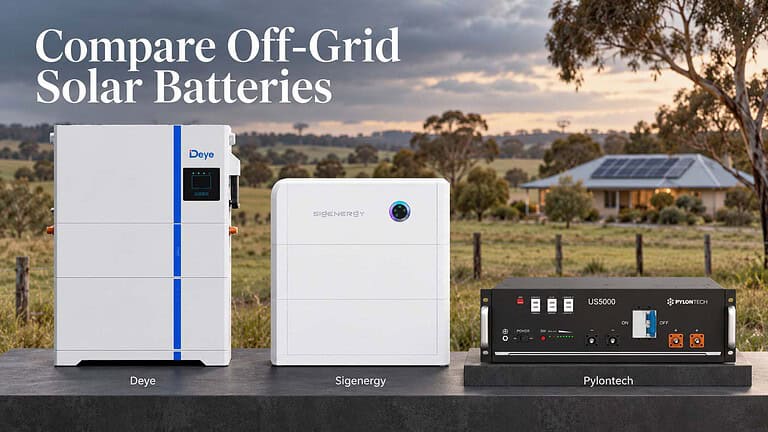
The following comparison covers the Pylontech US5000-B, Deye AI-W5.1-B and Sigenergy SigenStor BAT 10.0. Specifications are shown per battery module; complete system capacity and output depend on the number of modules and the inverter configuration.
Capacity and Voltage
| Specification | Pylontech US5000-B | Deye AI-W5.1-B | Sigenergy SigenStor BAT 10.0 |
|---|---|---|---|
| Battery chemistry | LFP | LFP | LFP |
| Nominal capacity | 4.8kWh | 5.12kWh | 9.04kWh |
| Usable capacity* | 4.56kWh | 5.12kWh | 8.76kWh |
| Battery architecture | Low-voltage, 48V nominal | Low-voltage, 51.2V nominal | High-voltage system |
Usable capacity is measured under specified test conditions; available energy varies with configuration and settings
Charge and Discharge Rates
| Specification | Pylontech US5000-B | Deye AI-W5.1-B | Sigenergy SigenStor BAT 10.0 |
|---|---|---|---|
| Normal or recommended charge/discharge current | 100A normal | 50A recommended | Specified by power below |
| Maximum charge/discharge current | Subject to operating and connection limits | 100A | Specified by power below |
| Peak charge/discharge current | Up to 200A for 15 seconds | 150A for 10 seconds at 25°C | Specified by power below |
| Published module power rating | Depends on operating voltage and current | 2.5kW rated DC power | 4.6kW maximum charge/discharge |
| Peak charge/discharge power | Depends on operating voltage and current | Depends on operating voltage and current | 6.9kW for 10 seconds |
Battery-side ratings do not equal household AC output. Available power also depends on the inverter, battery configuration, temperature and state of charge. Pylontech specifications vary between document revisions, so confirm the supplied US5000-B’s manual and cable limits
Temperature and Installation Environment
| Specification | Pylontech US5000-B | Deye AI-W5.1-B | Sigenergy SigenStor BAT 10.0 |
|---|---|---|---|
| Charging temperature | Confirm against supplied model manual | 0°C to 55°C; down to −20°C with heating on | Published overall operating range: −20°C to 55°C |
| Discharging temperature | Confirm against supplied model manual | −20°C to 55°C | Published overall operating range: −20°C to 55°C |
| Enclosure protection | IP20 | IP65 after stacking | IP66 |
| Installation format | Rack-mounted | Floor-mounted stack | Floor-standing or wall-mounted |
Sigenergy’s overall operating range should not be interpreted as unrestricted charging across that entire range. Follow each manufacturer’s installation and temperature requirements. An IP rating describes enclosure protection. It does not establish overall suitability for harsh environments; temperature limits and installation requirements also need consideration.
Additional Features
| Feature | Pylontech US5000-B | Deye AI-W5.1-B | Sigenergy SigenStor BAT 10.0 |
|---|---|---|---|
| Expansion | Up to 16 modules per string, subject to system requirements | Modular expansion within the selected Spring system configuration | 1–6 modules per controller |
| Integration | Separate compatible inverter/charger required | Battery module used within Deye’s Spring all-in-one system | Battery module used with compatible Sigenergy controllers |
| Battery management | Integrated protection and inverter communication | Integrated BMS; CAN and RS485 communication | Module optimisers support expansion with old and new batteries within manufacturer requirements |
| Main configuration consideration | Inverter compatibility and rack/cable design | Inverter rating, module count and stack arrangement | Controller rating, module count and approved configuration |
Expansion capacity and complete system output must be checked against the selected equipment combination.
Referenced product datasheets are available here:
Real Ballarat Off Grid Power Installs and the Batteries they use.
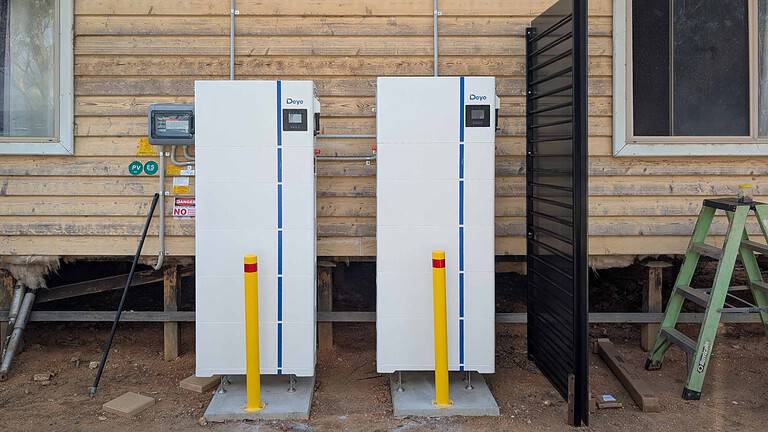
Ballarat
20 kW of off-grid inverter power with 40.8 kWh of battery storage
Full-Time Living · High Demand Use · Future Growth
- Solar
- 28.5 kW
- Inverter
- 20 kW
- Battery
- 40.8 kWh

Ballarat, Victoria
New Ballarat Home Gets Dual Sigenergy Inverters for 12kW Off-Grid Power with Built-In Redundancy
Everyday Off-Grid Power · Family Homes · Future Growth
- Solar
- 12 kW
- Inverter
- 12 kW
Australian Battery Uptake and Incentives
The Clean Energy Regulator recorded 207,308 solar battery installations from July to December 2025, followed by 339,481 from January to September 2026. That is a total of 546,789 (from the Clean Energy Regulator data as of Sept 2026) under the Small-scale Renewable Energy Scheme. The figures exclude pending registrations and failed applications though.
This uptake follows the introduction of the Cheaper Home Batteries Program in July 2025. This upfront discount on eligible battery installations uses small-scale technology certificates (STCs). The incentive reduces the initial cost of adding storage to new and existing solar systems and covers both off grid and grid tied systems.
Learn more about Battery incentives and rebates for off grid systems
Choosing Storage That Suits the System
Pylontech, Deye and Sigenergy offer different approaches to battery storage. Compare usable capacity, power output, inverter compatibility, expansion options and warranty terms against the property’s requirements.
For an existing solar system, check how much surplus energy is available to charge the battery, particularly in winter. For a fully off-grid property, assess household loads, winter solar production and how long the batteries need to supply power between charges.