
Off-grid solar calculator for homes in regional Victoria
Find the solar, battery and inverter size your home needs. Sized for a Ballarat July, not a sunny average.

Off grid solar calculator
What system capacity will power my home?
Tell us who lives there and what you plan to use. Calculate your off-grid solar requirements, including panels, battery storage and inverter capacity.
The off-grid calculator gives you a starting point. We check every design against your site and power needs.
Where to start
Start with daily electricity usage, then plan for winter
An on-grid home can draw from the grid when solar falls short. Off-grid, your panels must generate enough power to run the home and recharge the battery.
We estimate energy consumption at 5 kWh a day for the house, plus 5 kWh for each person. A home for three uses about 20 kWh a day.
Then we work out how many panels you need for July and storage for two grey days in a row. A system based on a sunny average runs short in winter.
- 5 kWh + 5 kWh a person
- System sized for July
- Two days of battery storage
- Inverter sized for large loads
How we size
Four rules behind a generator-less solar power system
Our goal is a solar panel system that works with battery storage to cover normal life without a generator. A generator can still be a backup. It just shouldn't do the work of a solar setup that's too small. What generator-less means.
Designed for full occupancy
Enough capacity for the household’s demands at full occupancy.
Built for worst-case winters
Solar capacity based on July, when an off-grid system works hardest.
Battery for low-solar days
Storage to carry the home through two grey days in a row.
Redundancy where it matters
A second path, so one failed part doesn't mean no power.
Rule 1
Enough power for a full house
We allow for everyone the home could hold. Families grow and homes get sold. A system built for two people today can fall short later.
How many people live at your place?
3-bedroom kitIndicative only — 5 kWh base + 5 kWh per person. Systems are sized to get through a Ballarat July without a generator; actual usage varies with appliances and habits.
Rule 2
Solar energy for worst-case winters
The energy produced by solar panels drops in winter. Days are short, the sun is low and grey days come in runs. So we use July as the starting point for every design.
June has the lowest average. But July brings the worst runs of grey days.
In half the years since 2005, the year's worst three days fell in July. That's why we plan around July and use hourly models.
-
WINTER
2.5 kWh
a day from 1 kW of panels in a Ballarat winter month.
-
YR AVG
3.9 kWh
a day from the same panels, averaged across the year.
-
WHY JULY?
37%
less in July than the yearly average. Plan around the yearly average and you risk a winter shortfall.
Learn More: Do solar panels work on cloudy days in Ballarat?
Modelled for Ballarat using PVGIS solar data (daily output, 2005 to 2020). 1 kW of panels facing north at 30 degrees, with 14% system losses.
Rule 3
Battery to get through low-solar days
Grey days often come two or three at a time. We base battery storage on two days of normal energy use, with little sun.
How much power do you use a day?
1 person ≈ 10 · 4 people ≈ 25 · farm or workshop 35+
A starting point for getting through consecutive low-solar days in a Ballarat July. Your final battery size is confirmed against your site and how you use power.
We calculate battery capacity in usable kilowatt-hours. Each brand gives a different amount of usable power, so module counts can mislead. What to compare before you buy a battery.
Rule 4
Redundancy where off-grid relies on it
With no grid behind you, one failed part can mean no power. Parts can take weeks to arrive. So where it makes sense, we design in a second path.
-
Redundancy
Dual inverters
If one inverter fails, the other keeps the essentials running.
-
Redundancy
Split battery banks
Two banks, so one fault doesn't take out all your storage.
-
Backup
Generator
Kept for a long run of grey days, or for repairs. It should rarely start.
-
Backup
EV as backup
Some EVs and chargers can send power back to the home. Check your car and charger first.
A good off-grid system rarely relies on a generator. How generator-less off-grid works.
Systems by Household
Custom Off-grid systems & kits by household
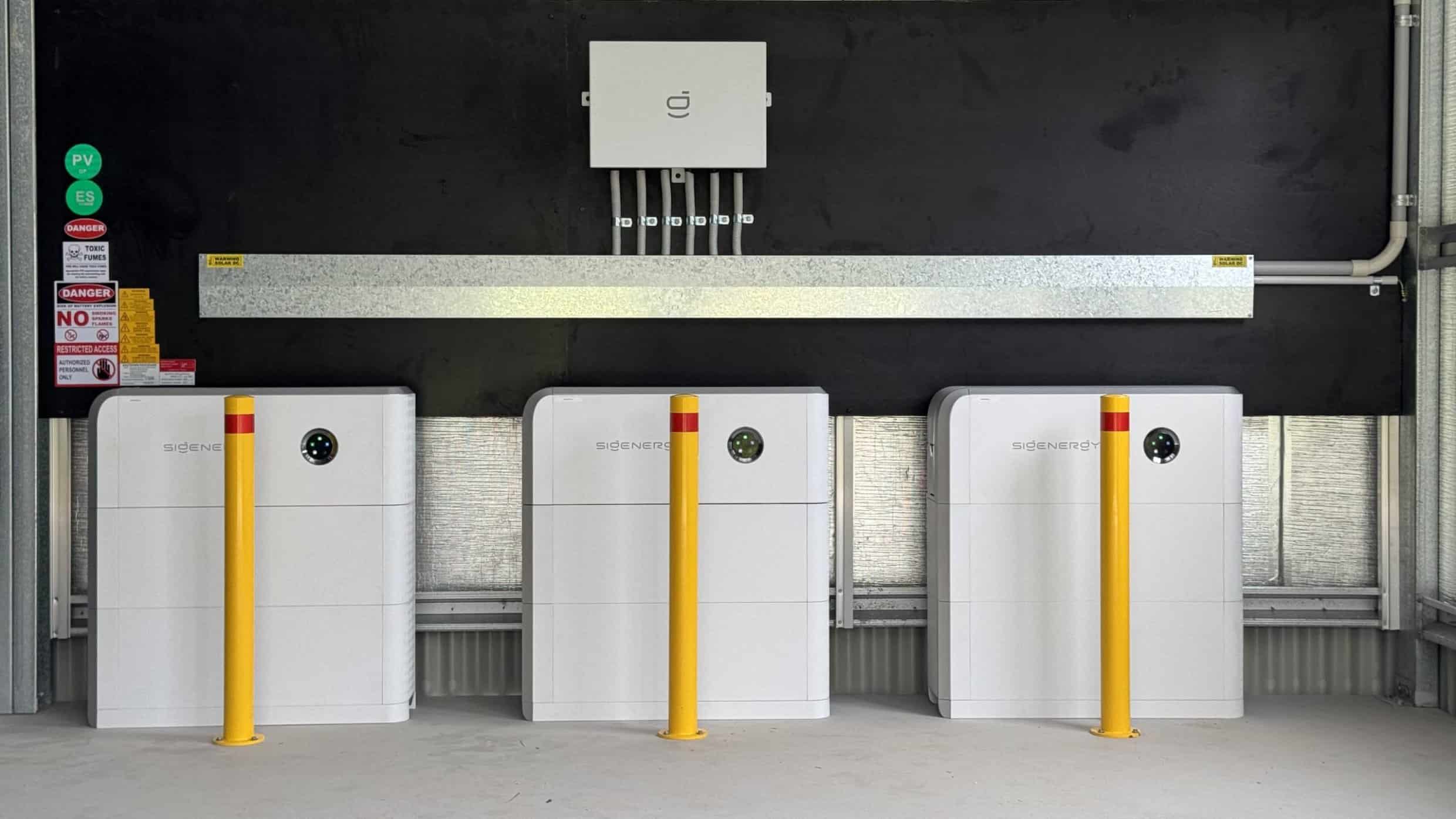
No two homes use power the same way. These show how the system grows as the load does.
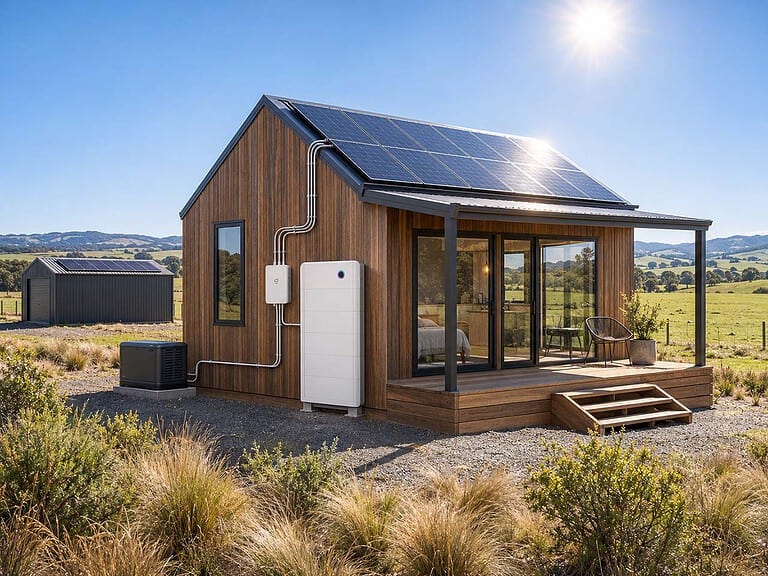
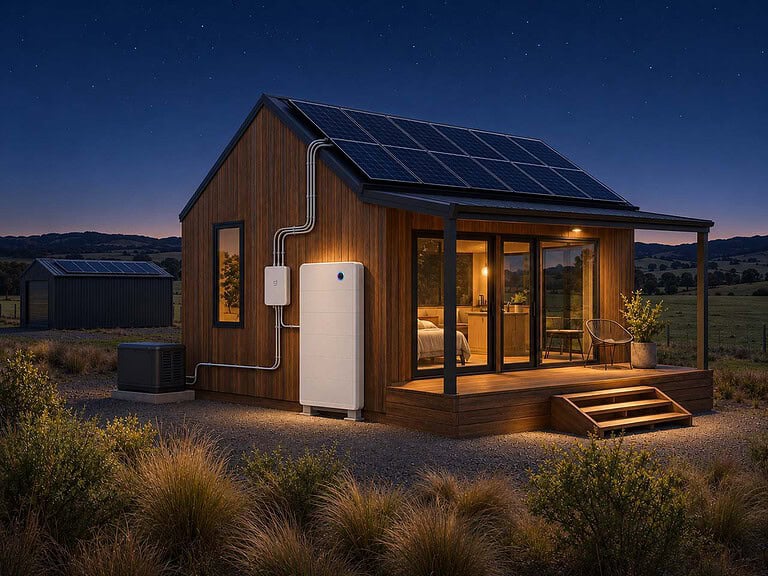
Small homes
Cabins, couples, granny flats and tiny homes.
- 10–20 kW inverter
- 36–51 kWh battery
- 12.83–23.75 kW solar


Everyday family homes
The family home, designed for 4 people.
- 20 kW inverter
- 45–51 kWh battery
- 29.93–32.3 kW solar


Large homes
Big families, home offices, EVs and pools.
- 20–30 kW inverter
- 54–63 kWh battery
- 36.58–43.23 kW solar
The inverter must handle what runs and starts together, like a bore pump starting while the oven is on. That's often a bigger number than your daily use suggests.
Your site
Your property still gets its own assessment
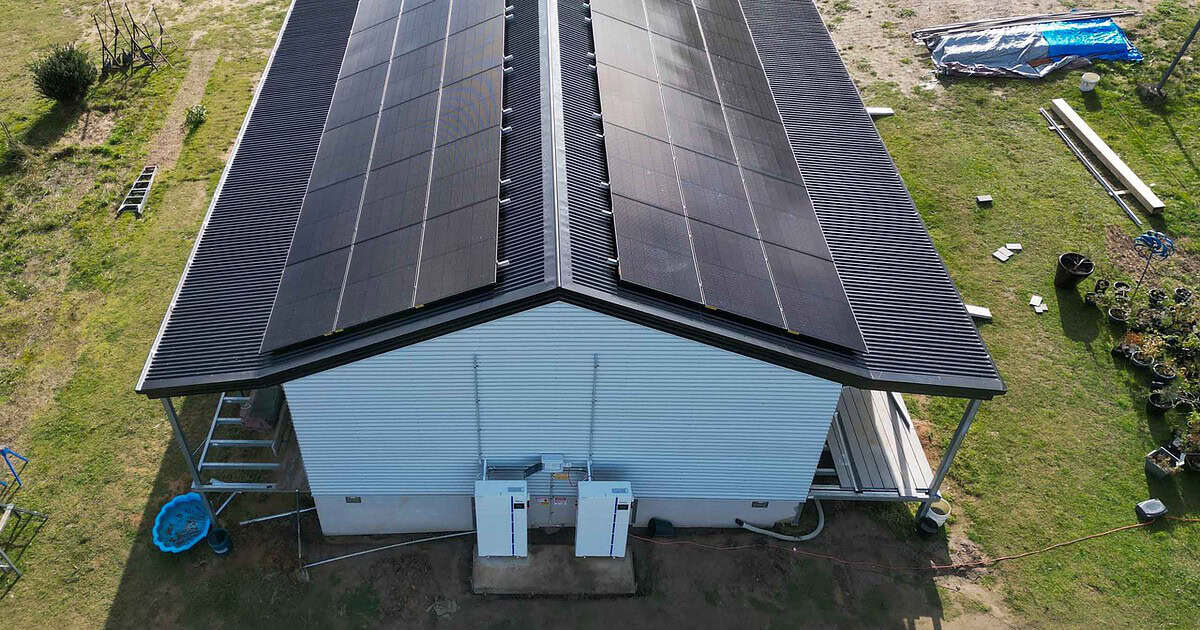
A calculator can't see the tree shading your shed rooftop. We check the site before we design the system.
- Roof direction
- Ground-mount options
- Panel tilt
- Shading and trees
- Bore pumps and heavy appliance loads
- Room to add panels later
-
1
Tell us about the property
Where it is, who lives there and what you run.
-
2
Work out real daily use
Today's needs plus the people the home could hold.
-
3
Model the whole system
A renewable energy system with backup, designed together for July.
-
4
Get your design and quote
The equipment, capacities and installation, in one proposal.
Questions
Off grid solar calculator FAQs
Start with your daily use. We use 5 kWh a day for the house plus 5 kWh for each person.
Then we calculate solar capacity for July, storage for two grey days and inverter power for the biggest loads that run together.
Divide your daily use by what 1 kW of panels makes in winter. In a Ballarat July, 1 kW makes about 2.5 kWh a day on average.
Then add room for grey days and for your site.
Multiply your daily use by the days the battery should cover. A home using 20 kWh a day needs 40 kWh of usable storage for two days.
The number of modules then depends on the brand.
Choose an inverter that can handle everything running at once, plus start-up surge.
A bore pump can draw several times its running power for a moment when it starts.
Not for normal life. We design the solar and battery to cover normal daily use without one.
Some people keep a generator as a backup for long grey runs or repairs.
Winter brings short days, low sun and runs of cloud. In Ballarat, July solar is about 37% below the yearly average.
On the grid you’d buy the shortfall. Off-grid, you have to make it.
It depends on your daily use, your battery capacity and your site.
No. It gets you into the right range.
Before we quote, we check your energy needs, your site, your winter sun and your plans.
Bedrooms are a rough guide. We design a 4-bedroom home for 5 people, or about 30 kWh a day.
Divide the total array wattage by your panel wattage to get the panel count.
Get System Sizing advice
Tell us about your property
Send us your calculator result and a few details. We'll tell you what size system makes sense.

Fred reads every enquiry himself. He's the one who designs, installs and looks after 100UP systems.
What we need to plan your system
- Who lives there, or will
- Special loads: bore pump, workshop, EV or heating
- Where the property is
- Your calculator result, if you have one