What solar system problems do we most often find around Ballarat?
Around Ballarat, the most common solar faults are usually found in the inverter, battery bank or the way the solar array is performing. The solar panels themselves often remain serviceable for many years. Inverters, batteries, isolators, cabling and other electrical components tend to show problems earlier.
Age is a major factor.
Many systems we inspect were installed 10 to 15 years ago, highlighting the importance of regular maintenance to extend their lifespan. Smaller 1.5kW, 2kW and 5kW systems were common at the time. Some are now reaching the point where individual components need repair or replacement.
Off-grid systems have another problem. Many older installations use lead-acid batteries and relatively small solar arrays. As battery capacity falls, the array may no longer have enough spare generation to recharge it properly, impacting the overall energy solution.
Household energy use can also increase over time. A system that worked well when it was installed may now be running a larger fridge, more appliances, pumps, workshop equipment or other loads it was never designed to supply. The first step in troubleshooting is simply to work out where the problem is occurring in the system and why. That is the basis of good solar system maintenance and fault diagnosis.
What are the most common off-grid solar inverter problems?
Inverter faults are among the most frequent problems we see in older off-grid setups around Ballarat. The inverter converts DC electricity from the solar panels or batteries into AC electricity used by the property. In an off-grid system, the inverter-charger may also control battery charging and interact with a backup generator.
When it develops a fault, the symptoms can range from occasional shutdowns to complete loss of power.
Common problems with Inverters
Typical inverter problems include:
- intermittent shutdowns
- repeated warning lights or fault codes
- no AC output
- unusually low solar production
- overheating
- cooling fan failure
- DC voltage outside the inverter’s operating range
- earth or insulation faults
- inverter failure caused by age
Older inverters deserve particular attention.
Residential solar inverters are commonly expected to operate for around 10 to 15 years. Equipment that has spent years exposed to heat, dust or poor ventilation may fail sooner. Location matters too.An inverter mounted where it receives strong afternoon or summer sun can run hotter than the same unit installed in a protected, well-ventilated position. Heat places extra stress on internal electronics and cooling components.
For more background, the Australian Government provides an overview of solar inverter technology and its role within a solar system.
Troubleshooting inverter faults
The exact fault code varies between manufacturers. A Victron fault number will not necessarily match a Selectronic fault number for the same underlying problem.
Fault code gives us a useful starting point. We can Identify the type of issues and to determine if the inverter can be repaired, needs routine maintenance or if there is a bigger issues at play.
- Overload or output over-current: The connected load is asking for more power than the inverter can provide. Pumps, welders and other equipment with high starting currents can trigger this. It can also indicate an undersized inverter. The can affect the overall lifespan of your renewable energy system.
- Over-temperature: The inverter is getting too hot. Poor ventilation, blocked airflow, a failed cooling fan or a hot installation location are common causes.
- DC over-voltage or under-voltage: The inverter is receiving voltage outside its operating range. The cause may be the panel string configuration, battery voltage, charging equipment or another DC-side fault.
- Low battery or low-voltage disconnect: The battery bank has fallen below the inverter’s operating threshold. The inverter may be reporting the symptom rather than causing the problem.
- Earth fault or insulation fault: This can point to damaged cabling, moisture ingress, deteriorating insulation or a problem within the solar array. It needs electrical testing.
- No AC output or inverter will not start: The inverter may have failed, but it is not the only possibility. A fuse, isolator, battery management system or another protection device may have shut the system down.
If an inverter displays a code, record the brand, model and exact code. Then troubleshoot potential issues with the system design. before resetting anything. That information can make diagnosis much faster.
How can you reduce the risk of inverter failures?
Keep the inverter area clear and well ventilated. Do not block cooling vents or stack equipment around the unit. Check monitoring data occasionally rather than waiting until the system stops altogether. Repeated warnings also deserve attention.
A low-voltage warning that appears every winter may not mean the inverter is failing. It could indicate a battery or solar sizing problem elsewhere in the system. That distinction matters because replacing a working inverter will not fix an undersized array or exhausted battery.
How long should I keep repairing an old solar inverter?
If an older inverter has one isolated fault while the rest of the solar energy system remains healthy, replacement of the inverter alone can make sense. The decision changes when several major components are ageing at the same time.
If the inverter, panels, battery equipment and switchgear are all approaching the end of their useful life, it is worth assessing the system as a whole before spending heavily on one component.
What battery problems occur in older off grid solar systems?
Battery storage faults have a particularly critical impact in off-grid systems. The battery is what sustaines energy independence through worse case winters and keps the property running when solar production falls. Around Ballarat, we still inspect many older systems built around flooded lead-acid or AGM battery banks. These storage systems lose usable capacity as they age. A battery bank can therefore appear to charge normally while storing far less energy than it did when new.
Battery storage problems we commonly see
Common symptoms include:
- batteries reaching low voltage much earlier than expected
- generator starting more frequently
- batteries charging quickly but discharging just as quickly
- reduced overnight autonomy
- individual batteries or cells behaving differently
- corrosion around terminals
- flooded batteries requiring frequent topping up
- lithium batteries shutting down through the battery management system
- repeated low-battery warnings at the inverter
In older off-grid systems, critically depleted lead-acid batteries can create a cycle of energy storage problems.
The battery stores less energy. It is discharged more deeply. The generator starts earlier. The weakened battery then has even less capacity available for the next cycle.
This is also why an inverter’s low battery warning should not automatically be treated as an inverter fault.
What battery faults and warnings can indicate
Low battery voltage can mean the battery is discharged, but the reason still needs to be found. It may indicate:
- an ageing battery bank
- insufficient solar charging
- unusually high household demand
- a faulty battery or cell
- a charging problem
- generator charging that is not operating correctly
With lithium batteries, a shutdown can also come from the battery management system (BMS). The BMS protects the battery when operating conditions move outside safe limits. A BMS shutdown therefore needs diagnosis before assuming the lithium battery itself has failed.
Battery maintenance & How can you reduce battery problems?
Battery maintenance depends heavily on battery chemistry. Flooded lead-acid batteries require more attention. Electrolyte levels and terminals need to be checked, and corrosion should not be ignored. AGM batteries remove some of that maintenance but still lose capacity with age and cycling.
Modern lithium iron phosphate batteries require less routine physical maintenance. Monitoring remains important because unusual charge behaviour or repeated BMS events can provide an early warning of another system problem.
You can read more about the differences between lead-acid and lithium battery technologies and our discussion of lithium battery options for solar systems.
Should I replace an old lead-acid battery bank with lithium?
Sometimes, but the battery cannot be considered in isolation. A modern lithium battery may not be a practical drop-in replacement for an old lead-acid bank. The existing inverter-charger, charging equipment and communications may not be compatible. This becomes particularly important with older 24V systems.
Twenty-four-volt systems were once common for small cabins and weekenders. For larger modern off-grid systems, 48V equipment provides a much wider range of battery and inverter options.
If a 24V battery bank has failed, it is worth assessing the complete electrical architecture before buying another battery simply because it matches the old voltage.
What solar panel and solar array problems cause poor system performance?
Solar panel faults are less common than inverter or battery failures, but the array can still be responsible for poor system performance. There is also an important difference between a faulty solar array and an undersized solar array.
- A faulty array is not producing what it should.
- An undersized array may be working perfectly but still cannot produce enough energy for the property.
We see both.
Solar array problems that limit energy independence
Possible solar-side problems include:
- damaged or degraded panels
- failed or deteriorating DC isolators
- damaged solar cabling
- moisture or insulation faults
- poor electrical connections
- individual strings producing less than expected
- shading that has developed since installation
- an array that is too small for current energy use
- an array that cannot recover the battery adequately during winter
Off-grid systems around Ballarat are particularly sensitive to solar array sizing. Winter gives the system less solar energy to work with. Several grey days in succession can expose a design that looked adequate during summer. That is why a well-designed off-grid solar and battery system needs to account for the difficult production periods, not only average annual output.
Do I need an onsite inspection to tell a faulty array from an undersized array?
Not Always, but testing helps separate the two. String voltage, insulation resistance and inverter input measurements can show whether part of the solar array has an electrical fault.
System monitoring provides another clue. If the array is producing roughly what its size and conditions allow, but the battery still cannot recover, the problem may be system sizing rather than failed panels.
The property’s energy demand also needs to be considered. An older off-grid system may have been adequate when installed but no longer match the way the household uses electricity today.
Our off-grid solar power system sizing calculator explains why generation, storage and household demand need to be considered together.
Can an undersized off-grid solar array be expanded to increase solar power production and consumption?
Often, yes. One option is to add another group of compatible solar panels with its own maximum power point tracking (MPPT) charge controller.
This can allow the original array to remain in service while the new array provides additional charging capacity. It is not suitable for every system. Panel voltage, string configuration, charge-controller limits, battery charging requirements and the condition of the existing equipment all need to be checked first.
In the right system, however, expanding the array can improve winter recovery without replacing every component.
How can you reduce solar array faults?
- Monitoring is one of the simplest tools.
- A sudden change in daily production deserves investigation, particularly when weather conditions have not changed.
- Physical inspections & Regular maintenance can also identify damaged cabling, deteriorating isolators, loose connections and mounting problems before they become larger faults.
- Panel cleaning may help where dirt, bird droppings or other contamination is materially blocking the modules. Cleaning, however, will not fix an electrical fault or compensate for an undersized array.
Should I repair my older solar energy system or replace it entirely?
It depends on what has failed and what condition the rest of the system is in.
A single failed component does not automatically justify replacing an entire energy system. If the panels are performing well and the electrical infrastructure remains sound, replacing a failed inverter may be the sensible option. The same applies to an isolated DC isolator, cable fault or another repairable component. The calculation changes when several parts of the system are reaching the end of their life together.
For example:
- an old inverter needs replacing
- the battery bank has lost most of its usable capacity
- the solar array is too small for current demand
- the new battery is incompatible with the existing inverter-charger
- ageing switchgear or cabling also requires work
At that point, repairing one component can simply move the problem to the next weakest part of the system. For an off-grid property, we also look at whether the existing design still suits the household. A replacement system should not reproduce the limitations that caused the old system to struggle. The useful question is therefore not simply “Can this component be repaired?” It is: “Does repairing this system give me a reliable system for the next several years?”
What maintenance can help prevent expensive off-grid energy system repairs?
Good solar maintenance is mostly about spotting changes before they become failures. You do not need to dismantle equipment or perform electrical testing yourself. There are several useful things an owner can watch to maintain energy independence and ensure system efficiency.
Check your monitoring. Look for unexplained drops in solar production, unusual battery behaviour or repeated inverter warnings.
Pay attention to performance and fault patterns. A fault that happens every hot afternoon suggests something different from a low-battery warning that appears during several cloudy winter days.
Keep inverter ventilation clear. Heat is hard on power electronics.
Inspect accessible equipment visually. Look for corrosion, obvious cable damage, water ingress or physical damage. Do not open electrical enclosures unless you are qualified to do so.
Maintain flooded lead-acid batteries correctly. Check electrolyte levels and terminal condition according to the battery manufacturer’s requirements.
Watch winter performance on off-grid systems. Frequent generator use or batteries failing to recover can be an early sign that storage capacity or solar generation is no longer adequate.
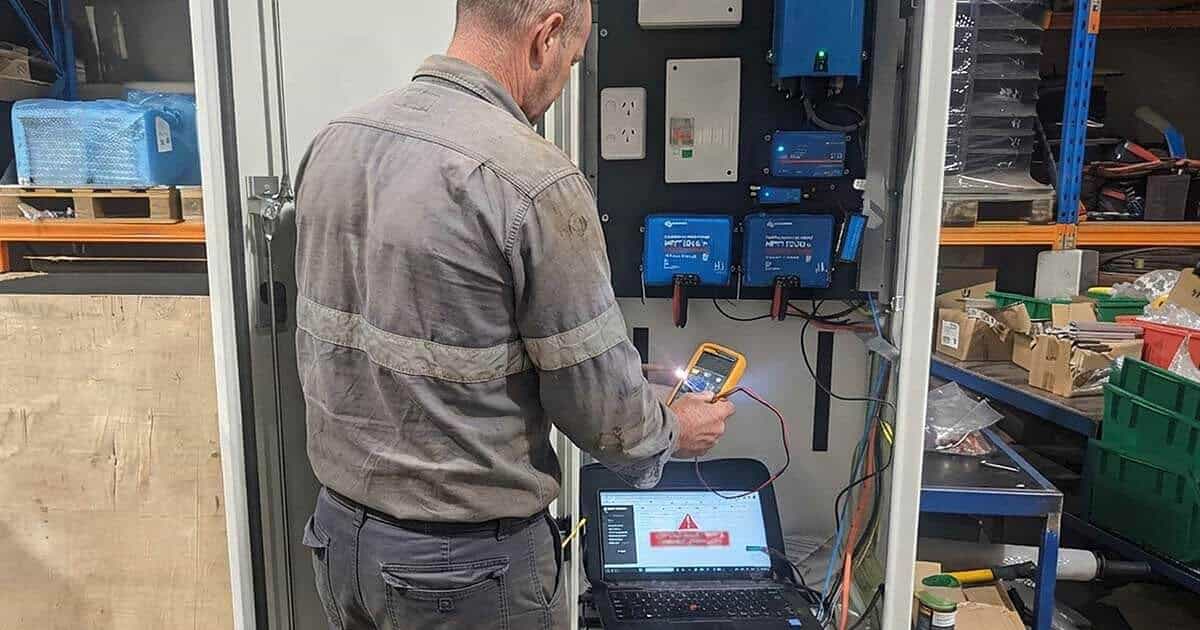
Electrical testing should be left to someone with the correct equipment and qualifications. A proper inspection can include checks of string voltage, insulation resistance, inverter performance, cabling, isolators and connections. The purpose is to establish whether the system is still operating as it was designed to.
How do solar repair and diagnostic services work for owners around Ballarat?
A useful diagnostic starts before any parts are replaced. If monitoring data is available, it can help identify when the fault occurs and which part of the system is behaving abnormally. An inverter fault code is also useful. Record the exact code, inverter brand and model if possible.
On site, the investigation can then move through the system logically. That may include checking:
- solar string voltages
- insulation resistance
- inverter input and output
- battery voltage and charging behaviour
- battery management system status
- isolators, fuses and protection equipment
- visible wiring and connection problems
- solar array performance
- the relationship between household demand, battery capacity and solar generation
For off-grid systems, we also need to consider the system as a complete energy supply. A low battery fault may actually start with insufficient solar generation. An inverter overload may point to a load the original system was never sized to run.That is why replacing the component displaying the error is not always the correct repair.
Our solar diagnostic and repair service covers existing systems in the Ballarat region. The aim of the diagnosis is to identify the actual fault first, then determine whether repair, expansion or replacement makes sense.
Frequently Asked off-grid solar system Questions
What is the typical lifespan of off-grid solar panels and components?
Solar panels typically last 20–30 years, while string inverters generally last around 10–15 years. Battery life depends heavily on chemistry and how the system is operated. Lead-acid batteries typically last 5–10 years, while lithium-ion batteries are commonly expected to last 10–15 years.
These are averages, not fixed replacement dates. Heat, deep battery cycling, poor ventilation, undersized solar arrays and repeated low-voltage events can shorten component life. In an older off-grid system, it is worth assessing the inverter, battery and solar array together rather than replacing parts based on age alone.
Why does my solar inverter keep switching off?
Repeated shutdowns can be caused by inverter overheating, DC voltage problems, grid conditions, battery voltage, overloads or an internal inverter fault. The error code and the conditions at the time of shutdown help narrow down the cause.
Does a low-battery inverter warning mean my inverter is faulty?
Not necessarily. It often means the inverter is responding to low battery voltage. The underlying cause may be the battery bank, charging system, solar array or household demand.
Why is my off-grid generator running more often than it used to?
Common causes include declining battery capacity, insufficient winter solar generation or increased household energy use. These problems can also occur together.
Are 24V battery systems still practical for off-grid solar?
They can still make sense for some small systems. For larger residential off-grid installations, 48V equipment generally provides more options for batteries, inverters and future expansion.
Can I keep my old solar panels when replacing the inverter?
Sometimes. If testing shows that the panels and strings are still performing properly, replacing the inverter alone may be reasonable. Compatibility and the overall age of the system still need to be assessed.
Are solar panel micro-cracks always a reason to replace a panel?
No. The important question is whether the damage is affecting output, safety or reliability. Electrical performance testing is more useful than assuming every visible defect requires replacement.
Can I add a battery to an existing grid-connected solar system?
Often, yes. The appropriate arrangement depends on the existing inverter, switchboard and proposed battery system. Compatibility should be checked before choosing the battery.
Can I add more panels to an older off-grid system?
Often, but not simply by connecting extra panels to the existing array. String voltage, MPPT capacity, battery charging limits and equipment compatibility need to be checked first.