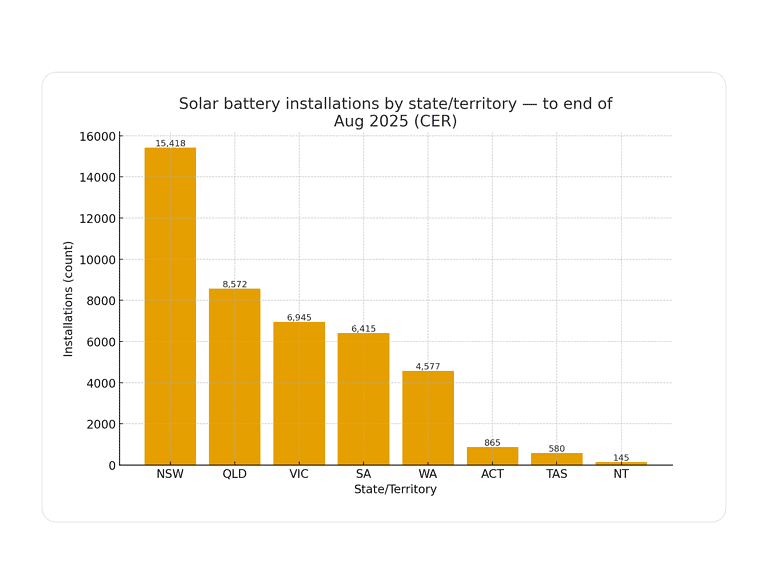
If you’ve been thinking about a home battery, you’re not alone. The Clean Energy Regulator (CER) just reported another big jump in installs — and there’s a clear shift to larger, more capable systems that move the needle on bills and backup.
The quick take
- 43,517 solar batteries have been installed with new or existing rooftop solar since 1 July 2025, when batteries became eligible under the Small-scale Renewable Energy Scheme (SRES). That’s 23,925 more than the CER’s July update.
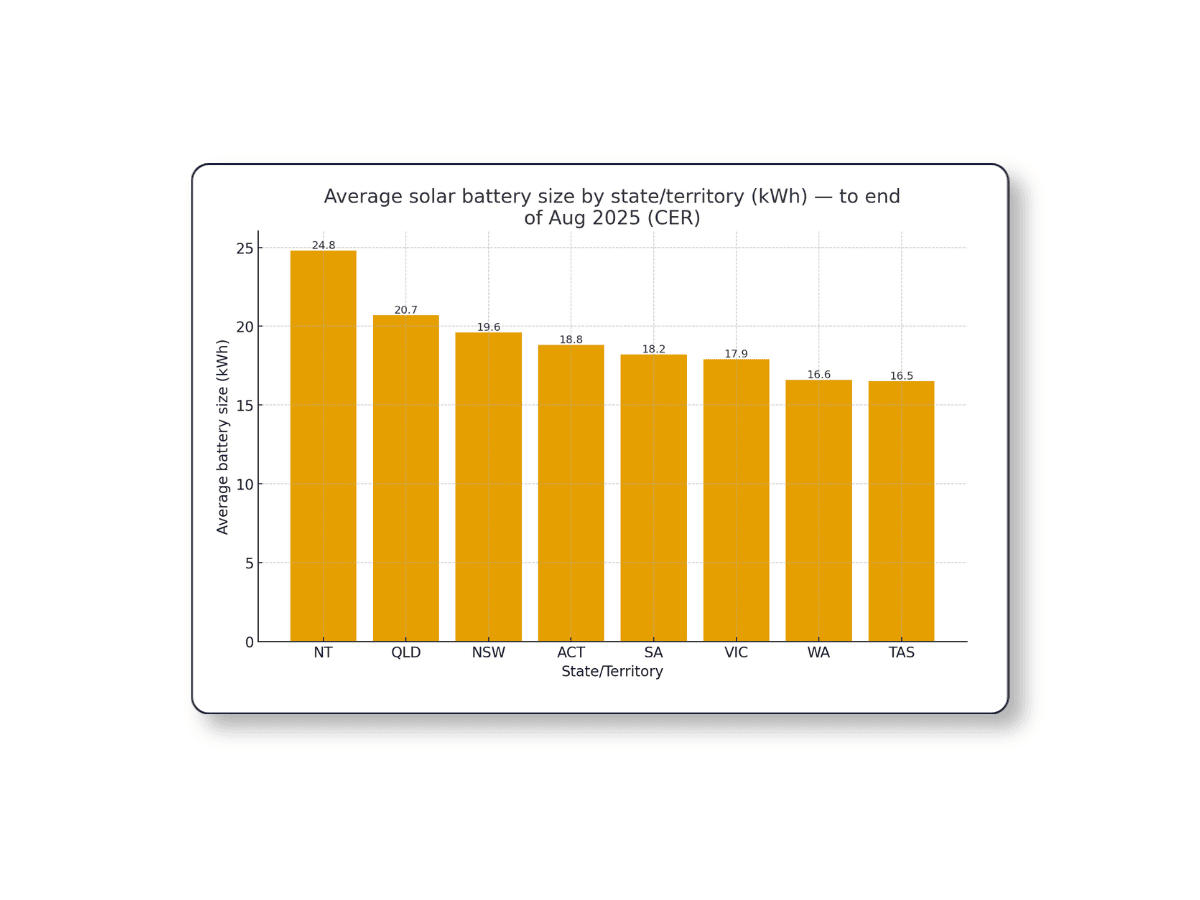
- The average battery size is ~19.0 kWh, with a combined nominal capacity of ~825 MWh added nationally.
- Figures include approved and pending STC applications (they exclude failed applications or systems that haven’t applied yet).
Context: Batteries became SRES-eligible on 1 July 2025 following regulation changes.
Why the surge?
From 1 July 2025, households and businesses can access a significant up-front discount (around 30%) on eligible batteries when installed with new or existing rooftop PV, delivered via STCs under the SRES. Early data shows this policy shift has driven strong uptake.
What size are people choosing?
The national average is sitting around 19 kWh. In practical terms, that’s close to the lower end of what many homes target for basic overnight autonomy. Going fully off-grid typically needs more storage and sufficient PV to cover winter and multi-day low-sun periods, but the average size now being installed is approaching that threshold for a lot of households. Clean Energy Regulator
State snapshots (to end of Aug 2025)
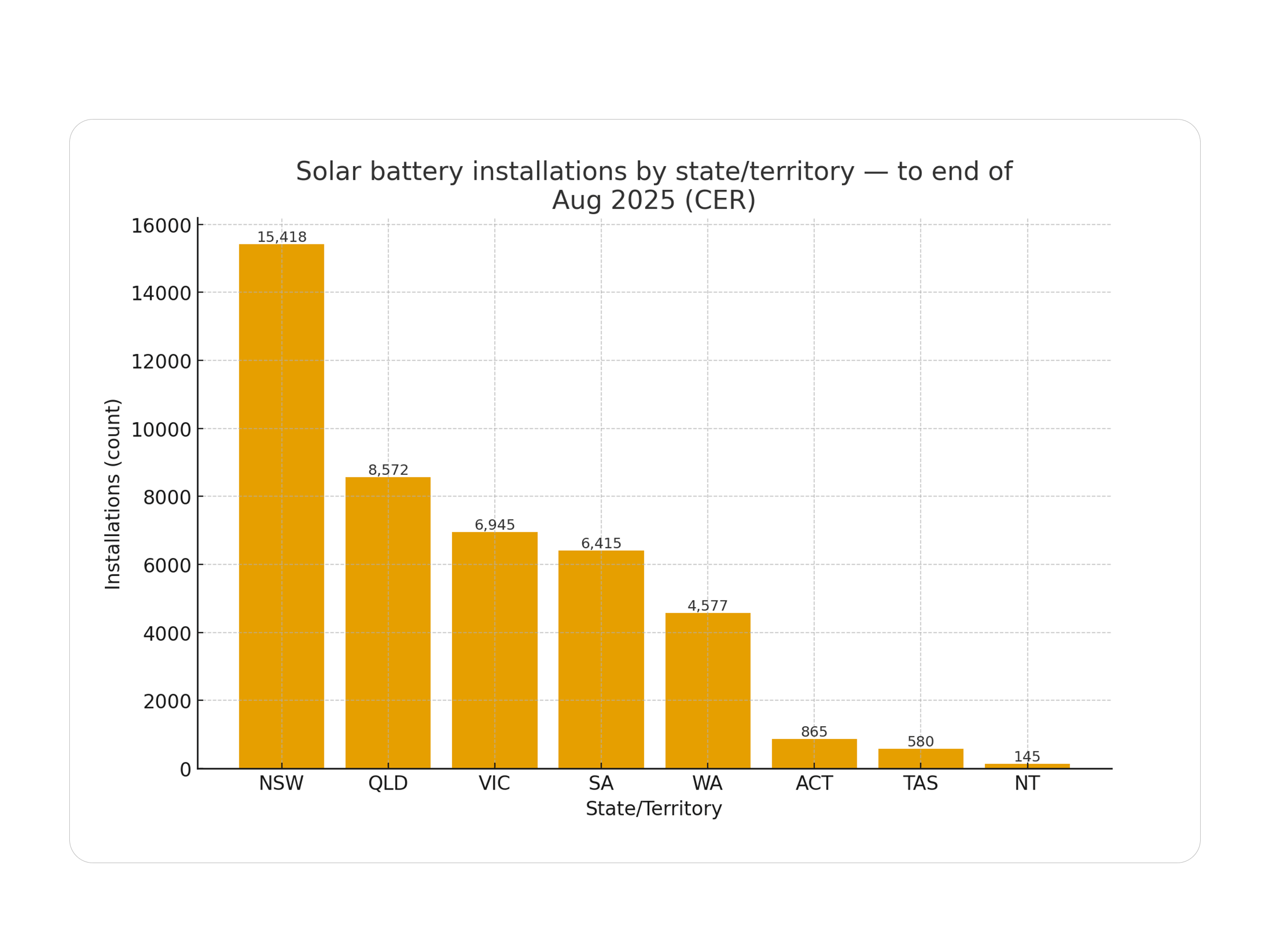
- NSW: 15,418 installs (avg 19.6 kWh)
- QLD: 8,572 (20.7 kWh)
- SA: 6,415 (18.2 kWh)
- VIC: 6,945 (17.9 kWh)
- WA: 4,577 (16.6 kWh)
- ACT: 865 (18.8 kWh)
- TAS: 580 (16.5 kWh)
- NT: 145 (24.8 kWh)
For approved-only counts (excluding pending), CER directs readers to the monthly small-scale installation postcode data; August battery postcode data will be added later in September.
How the incentives work (short version)
- SRES/STCs for batteries: From 1 July 2025, eligible batteries paired with rooftop PV can create STCs. The Australian Government funds the battery discount through the STC clearing house.
- Eligibility envelope: Battery nominal capacity must generally be 5–100 kWh (inclusive). Clean Energy Regulator
Bottom line
Battery adoption is accelerating across Australia, and system sizes are trending larger. With an average around 19 kWh, many households are getting close to the storage level associated with basic overnight coverage—a meaningful step toward deeper energy independence, provided PV capacity and winter performance are sized appropriately.