








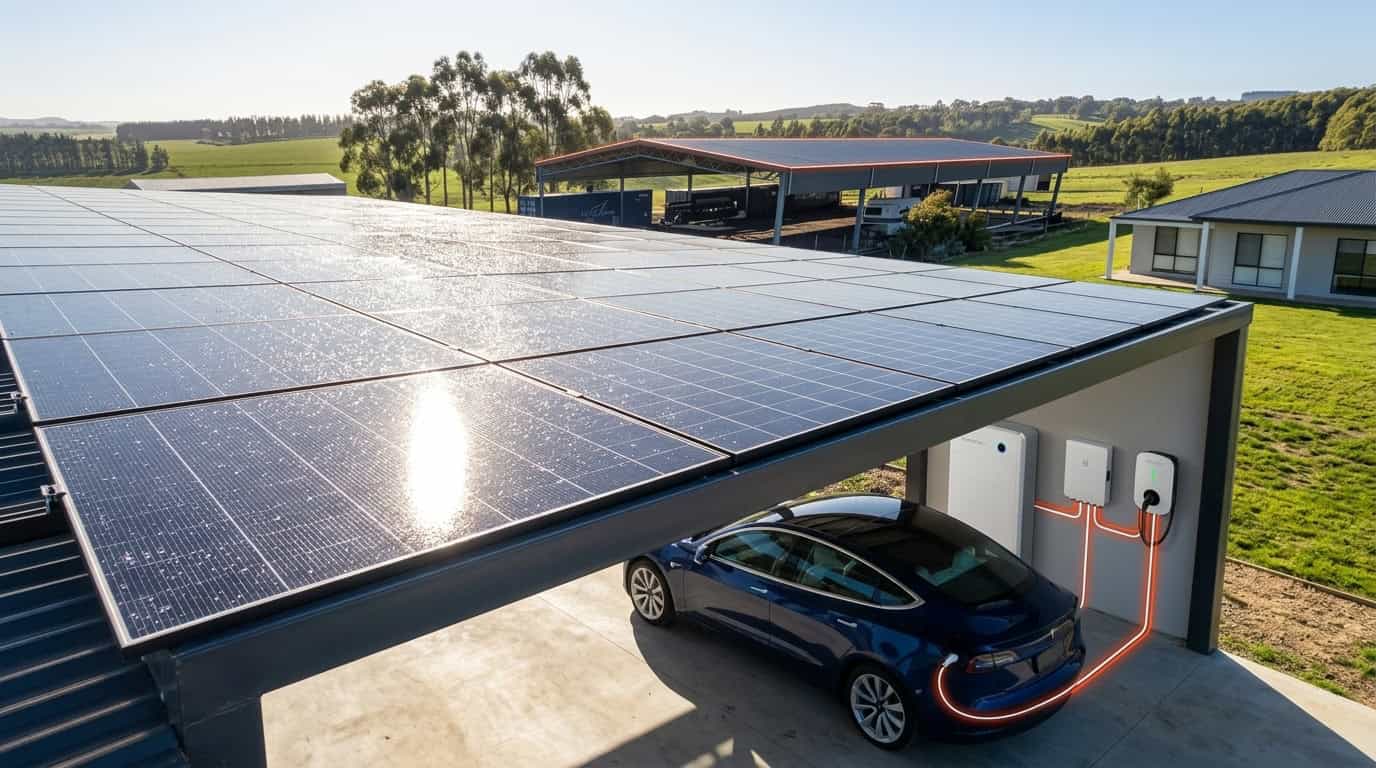
Power use in a weekender is rarely predictable. A property might sit empty for weeks, then need to run everything the moment someone arrives. The system needs to handle both without wasting money on unnecessary capacity.
It depends. Installing an off-grid system during construction can make it easier to design the home around the power system instead of retrofitting it later. That usually means cleaner cabling, better equipment locations, and efficiencies for installation costs.
For off-grid homes, it also means designing in clear upgrade paths from day one. You’ll want to consider running extra conduit, allow space for additional batteries and inverters, and size the electrical room for future expansion. Even if you don’t install the full system on day one, having the infrastructure in place makes future upgrades much simpler and more economical.
On the flip side, the home’s final energy use isn’t always known, so installing too early can make system sizing more challenging. Pre-construction off-grid systems need an experienced designer who understands the property’s solar resource, likely future loads, and how the system can expand over time. Not every battery and inverter platform scales easily, so planning the upgrade path from the beginning can avoid expensive changes later.
Here’s a rough guide to installed system costs in Australia:
| Household Size | Typical System | Installed Cost (approx.) |
|---|---|---|
| 1–2 people | 5–8 kW | $18,000 – $22,000 |
| 3 people | 10 kW | $28,000 – $30,000 |
| 4 people | 15 kW | $34,000 – $38,000 |
| 5+ people | 20 kW | $46,000 – $50,000 |
Prices are approximate and after rebates. System cost varies by location, equipment quality, and battery storage required.
Worth keeping in mind: connecting a rural property to the grid typically starts at $25,000. Figures of $60,000 to $100,000 are common. Against that, an off-grid system starts to look like the rational choice.
Yes — where the vehicle and charger support bidirectional (vehicle-to-home) operation.
A V2H charger lets the car battery feed the home during extended cloud, peak evening cooking load, or when the home bank is low — then recharge from solar when production returns.
Not every EV or charger supports this yet. Check vehicle spec and charger compatibility before assuming V2H.
On large 5-bed properties with events or extended family, an EV adds a meaningful second storage reserve beyond the home battery bank — worth planning into system design as the technology becomes more common.
Yes. Every 100UP system is sized for maximum occupancy — not just who’s living there today.
The 100UP Way: 5 kWh for the house, plus 5 kWh per person by bedroom capacity. A 4-bedroom install is engineered for up to eight people — heating, hot water, cooking, appliances running together.
That covers family visits, Airbnb guests, changing household size, and resale — a buyer isn’t inheriting a system that only worked for two people.
Full house, full load — that’s the scenario we design for.
If you might add an EV, more appliances, more people, or heavier heating/cooling in the next 3–5 years, plan expansion now — retrofitting an undersized platform costs more than sizing the infrastructure correctly upfront.
Prevention approach:
Simpler only makes sense when usage is genuinely stable — no family change, no EV, no new heavy loads. Most households grow energy demand over time.
100UP’s default: plan for expansion. Lower cost now, fewer expensive regrets later.

Fred installed our solar. Very honest very reliable. He goes above and beyond. Tries his best to help. Does a great job. I recommend.
Dino Papa
Verify reviewQuotation & installation process. They have been unfailingly helpful and never failed to communicate pro-actively & effectively.
Andrew Webb
Verify reviewFred did a great job was extremely patient with the slow build Clean and tidy Explained what he was doing along the process
Darcy Joynson
Verify reviewFred installed our system 2 years ago and it has been fantastic. Fred was great and efficient, great communication. Highly recommended
Hayley Richards
Verify reviewUpdated our off grid solar. Cannot recommend this company enough. Fred is very Knowledgeable, honest and very reliable. Great Job.
Lesley
Verify review